
Home / Solutions / Network Patch Management
Network Patch Management
Know which advisories matter, by the next morning.
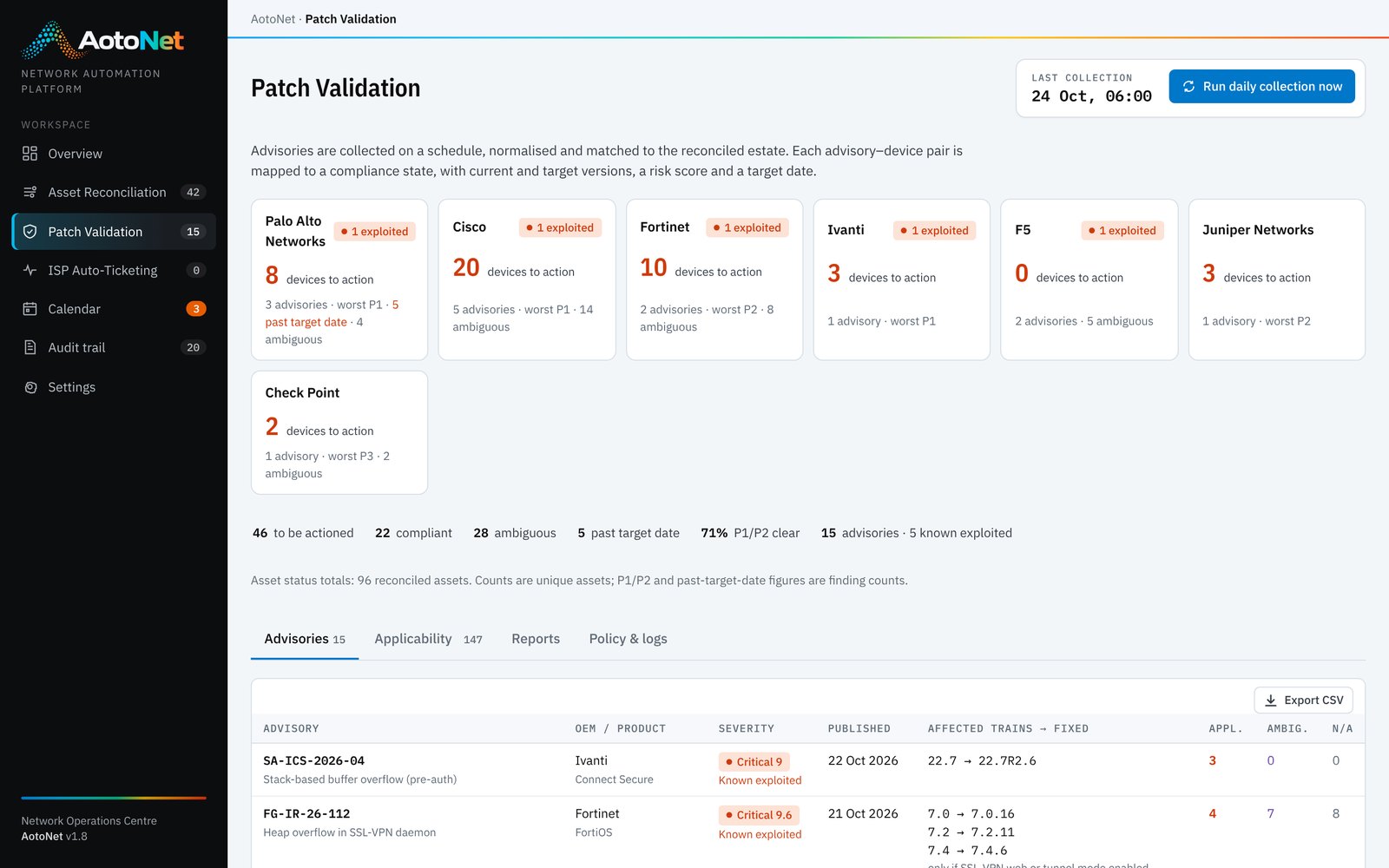
Every network vendor publishes security advisories on its own schedule and in its own version format. AotoNet collects them daily, checks them against the running version of every device, and tracks each finding until the fix is verified.
The challenge
Why the traditional approach breaks down
Network patching is usually handled by engineers working through vendor portals, mailing lists and spreadsheets.
Each vendor has its own portal, format and publishing rhythm; nothing arrives in one place.
10.2.9-h1, 9.18(4)29, R81.20 Take 89 and 22.4R3-S2 cannot be compared with a spreadsheet formula.
Matching advisories to an old export misses devices and flags ones already patched.
Advisories that apply only when a feature is enabled lead to over-patching or missed exposure.
Without consistent risk scoring and SLA dates, exploited vulnerabilities wait like routine ones.
Closure is rarely verified, so the audit question "how do you know?" has no good answer.
Two ways to do the job
From manual effort to an automated pipeline
How it is done today
Network patching is usually handled by engineers working through vendor portals, mailing lists and spreadsheets.
- Watch every vendorCheck each OEM security portal and mailing list for new advisories.
- Read each advisoryWork out the affected trains, fixed releases, models and feature conditions.
- Pull the inventoryExport device versions, often from a source that is weeks out of date.
- Compare by handLine up versions per train and per model, and guess whether the vulnerable feature is enabled.
- Prioritise and trackAssign priority by judgement and track deadlines in a sheet.
- Patch and hopeApply the upgrade in a change window; confirmation that it worked is rarely recorded.
How AotoNet automates it
AotoNet turns patching into a daily, evidence-based pipeline.
- Collect advisories dailyOEM security feeds and national CERT advisories via CSAF, RSS and vendor APIs.
- Normalise the advisoryProduct, affected trains, fixed releases, conditions, CVSS and exploitation status in one format.
- Match to real devicesVendor-aware version comparison against the reconciled inventory, not a stale export.
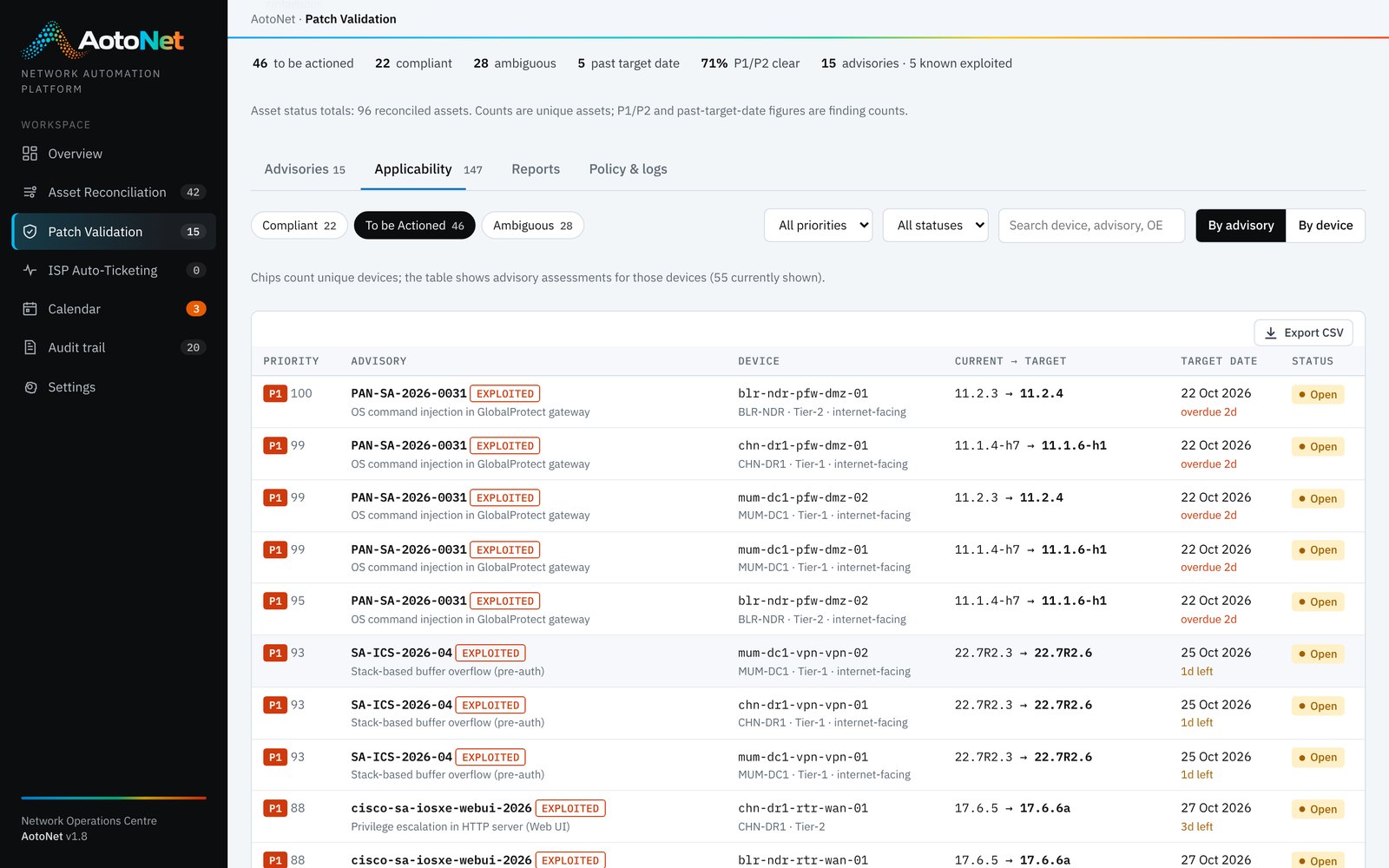
- Decide applicabilityApplicable, Not Applicable or Ambiguous for every advisory and device, with the reason and the target version.
- Score risk and set the SLASeverity, known exploitation, internet exposure and asset criticality give a priority and a due date.
- Drive the workflowChange requests, exceptions with expiry and compensating controls, and approvals.
- Verify the fixThe running version is re-checked after the window; a finding closes only on evidence.
- Report complianceStatus by vendor, platform and site, SLA ageing and a daily validation report.
Side by side
What changes, point by point
| Aspect | Traditional approach | With AotoNet |
|---|---|---|
| Advisory intake | Manual checks of each vendor portal and mailing list | Collected daily from vendor feeds and CERT advisories |
| Affected devices | Engineer judgement against an old export | Matched to the current reconciled inventory |
| Version logic | Spreadsheet comparisons that break on vendor formats | Vendor-aware comparison per release train and model |
| Unclear cases | Silently assumed applicable or ignored | Marked Ambiguous with the reason, for an analyst decision |
| Prioritisation | Severity alone, or gut feel | Risk score from CVSS, exploitation, exposure and criticality, with an SLA date |
| Closure | Assumed after the change window | Verified by re-checking the running version |
| Audit | Assembled by hand when asked | Daily compliance reports and a full decision history |
Capabilities
What Network Patch Management includes
Multi-vendor advisory collection
Firewalls, routers, switches, load balancers, VPN gateways and NAC from vendors such as Palo Alto Networks, Fortinet, Cisco, Check Point, Juniper, F5 and Ivanti.
Three-state applicability
Applicable, Not Applicable and Ambiguous, each with current and target version and a written reason.
Configurable risk and SLA policy
Weights for exploitation, exposure and criticality, and SLA days per priority, set to your policy.
Exceptions with expiry
Risk acceptance with justification, compensating control, approver and an end date.
Change workflow
Change requests pre-filled with implementation, back-out and test plans.
Compliance reporting
By vendor, platform and site, with SLA ageing and an exportable daily report.
Benefits of automation
What your team gains
Exploited, internet-facing vulnerabilities rise to the top on the day they are published.
Engineers work on applicable findings, not on reading every advisory.
SLA dates and ageing make overdue patches visible before they become findings.
Every closure is backed by the version actually running on the device.
Connects to
Same platform, same data
Works hand in hand with
See Network Patch Management on your own network.
Book a 30-minute walkthrough, then run a pilot on a sample of your own data.