
The challenge
Why the traditional approach breaks down
In most network teams, reconciliation is a periodic spreadsheet exercise run before an audit.
Upgrades, replacements and moves happen every week; reconciliation happens every quarter.
Different hostname, serial and version formats make identical devices look different.
Devices on the network but not in the CMDB are left out of patching, change and incident processes.
Decommissioned devices stay "installed" and refreshed hardware gets a second record.
When an auditor asks why a record changed, the answer is in someone's inbox.
Patching, change risk and incident routing all depend on an inventory nobody trusts.
Two ways to do the job
From manual effort to an automated pipeline
How it is done today
In most network teams, reconciliation is a periodic spreadsheet exercise run before an audit.
- Export everythingCIs from the CMDB, node lists from monitoring, device lists from firewall managers and discovery tools.
- Line it up by handLookups on hostname or IP, even though each tool formats names, serials and versions differently.
- Chase the ownersEmail every device owner about each mismatch and wait for answers.
- Update the CMDB manuallyKey in corrections one by one, without a record of why each change was made.
- Repeat next quarterBy then the network has changed and the spreadsheet is out of date.
How AotoNet automates it
AotoNet runs the same job continuously, with rules instead of spreadsheets.
- Connect the sourcesCMDB, network monitoring and observability tools, device managers and discovery, read on a schedule.
- Normalise identifiersHostnames, serials, vendors, models, OS versions, IPs and sites cleaned into one canonical model.
- Match deterministicallySerial first, then hostname and IP, then weaker keys, each link scored for confidence.
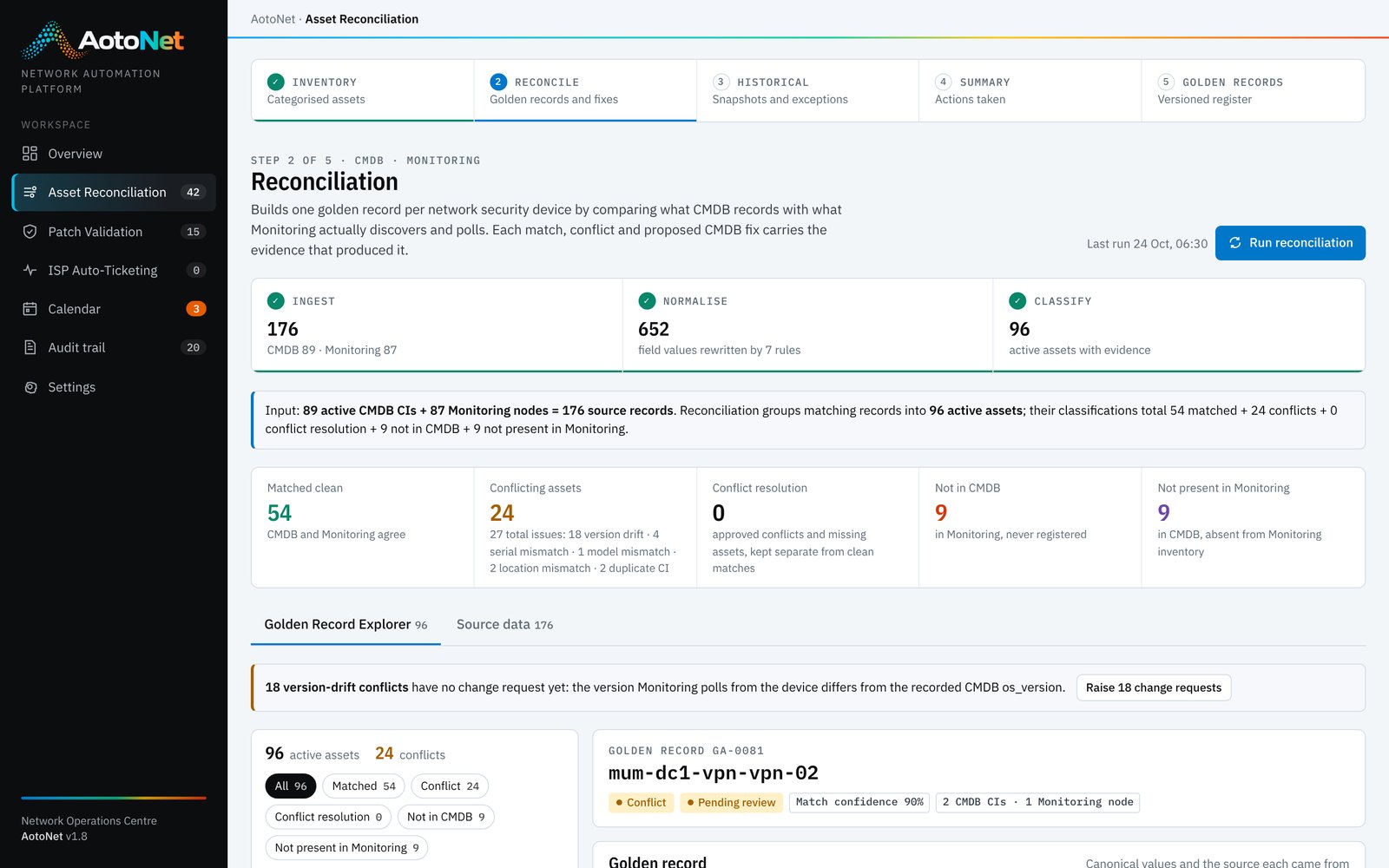
- Classify every deviceMatched, conflict, missing from the CMDB, or not seen by monitoring, with the reason.
- Propose the fixEach correction is drafted as a CMDB update and routed for review and approval.
- Keep the evidenceGolden records are versioned, with field-level lineage and a full action history.
Side by side
What changes, point by point
| Aspect | Traditional approach | With AotoNet |
|---|---|---|
| Frequency | Quarterly, or before an audit | Every run, on a schedule you set |
| Matching | Lookups on names that rarely agree | Deterministic rules on normalised identifiers, with confidence scores |
| Conflicts | Found by chance, explained by no one | Classified by type: version drift, serial, model, location, duplicate CI |
| Missing devices | Rarely noticed | Devices missing from the CMDB and CIs that monitoring never sees, listed every run |
| Corrections | Manual edits after email chases | Drafted CMDB updates with review, approval and change requests |
| Evidence | Spreadsheet versions | Field-level lineage, versioned golden records and an audit trail |
| Team effort | Days of data wrangling per cycle | Review only the exceptions |
Capabilities
What Asset Reconciliation includes
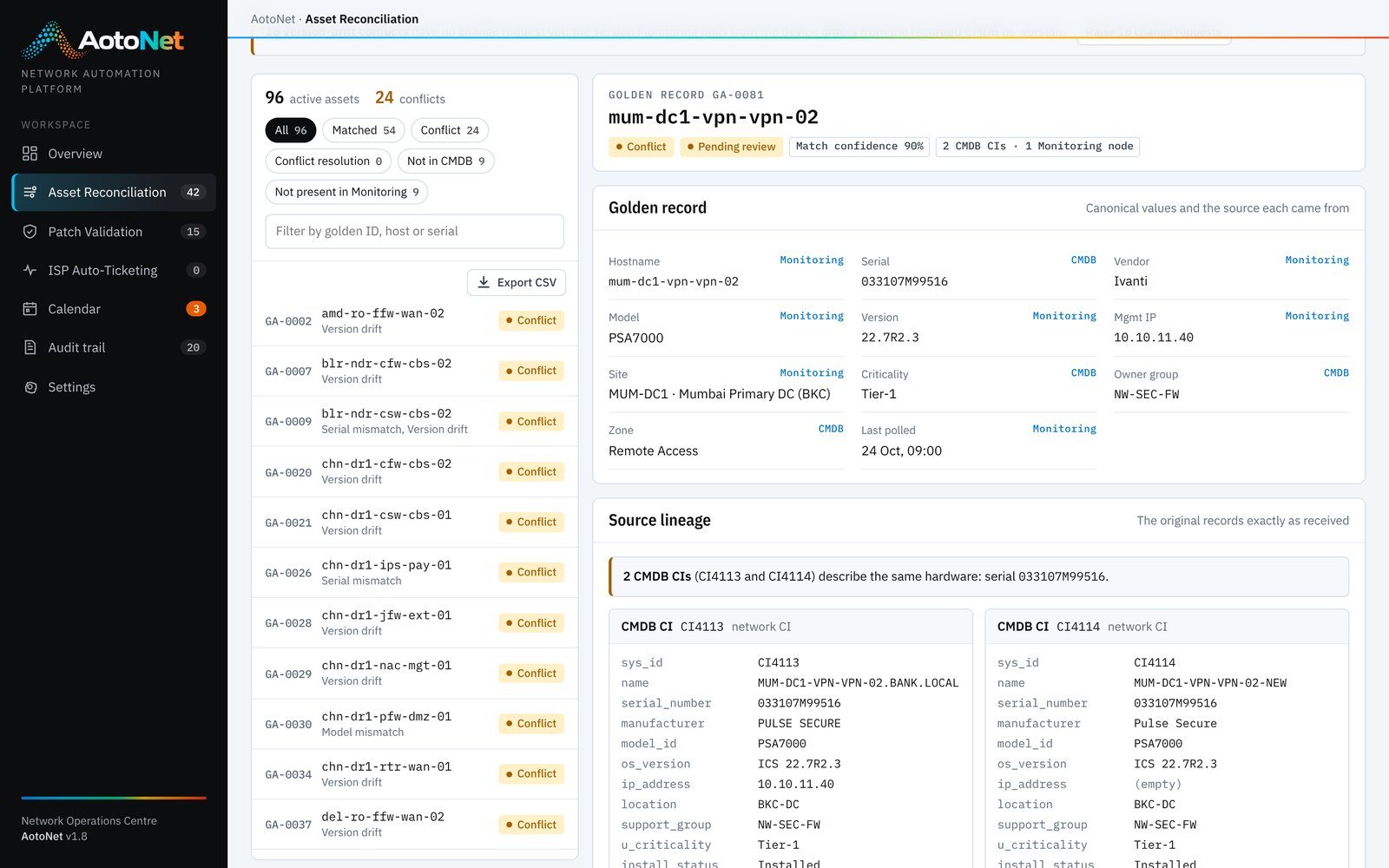
Golden Record Explorer
Every device on one screen: canonical values, the source of each field, the original records and the match evidence.
Configurable rule workbook
Normalisation, matching hierarchy and source precedence defined as rules your team can read and change.
Conflict classification
Version drift, serial and model mismatches, wrong locations and duplicate CIs, each with the proposed value.
Inventory gap detection
Unregistered devices found on the network and stale CIs that no tool can see.
Approval workflow
Change requests with comments, review and escalation before anything is written back.
History and versions
Snapshots of every run and a versioned golden-record register for audits and trend analysis.
Benefits of automation
What your team gains
Change, incident and patch processes run on accurate device data.
Every record shows where its values came from and who approved each change.
Unregistered devices come into patching, monitoring and change control.
Teams review exceptions instead of rebuilding spreadsheets.
Connects to
Same platform, same data
Works hand in hand with
See Asset Reconciliation on your own network.
Book a 30-minute walkthrough, then run a pilot on a sample of your own data.