
Home / Solutions / ISP Ticket Management
ISP Ticket Management
The ISP hears about the outage before your users do.
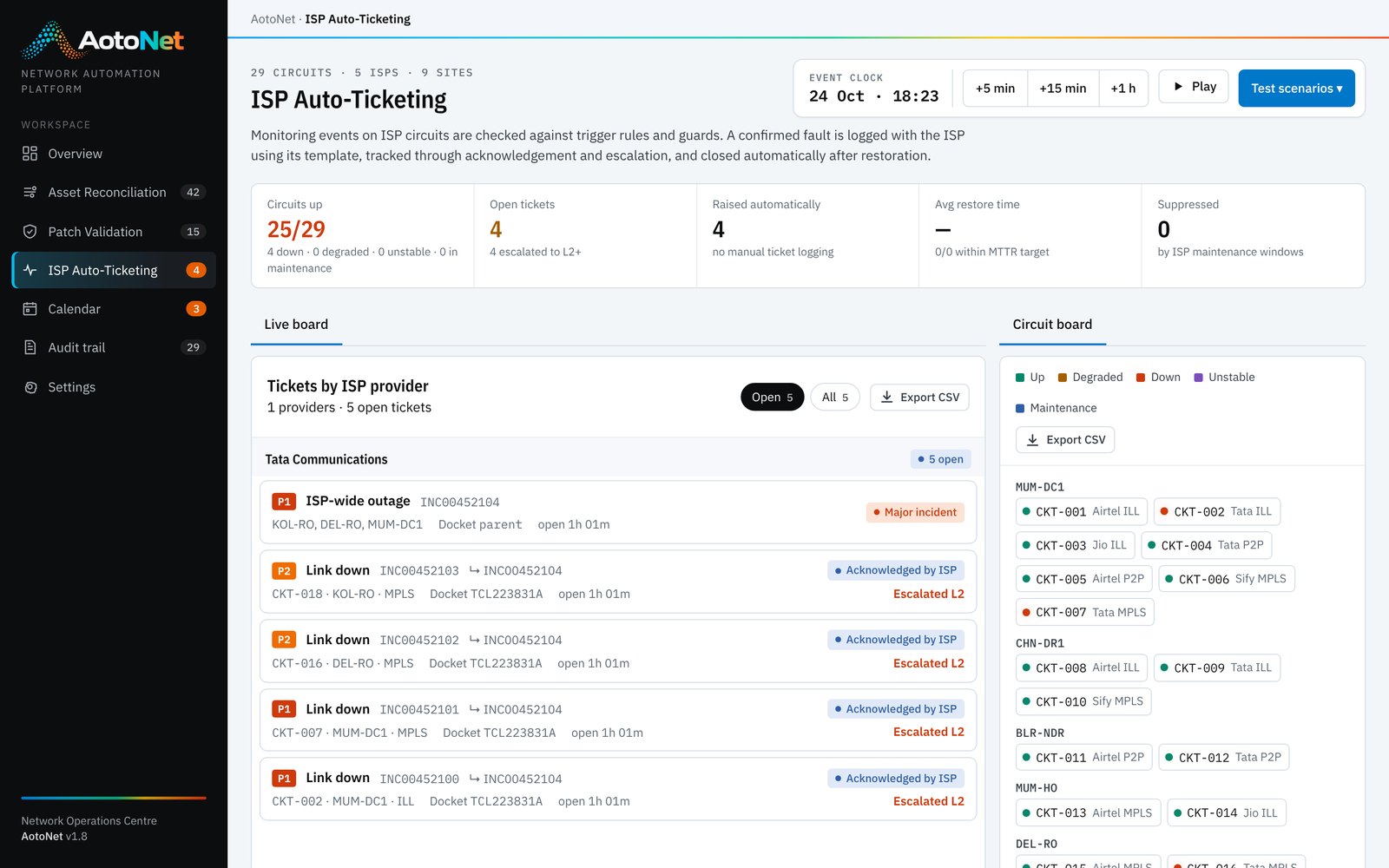
When a carrier circuit fails, every minute between the alarm and the ISP ticket adds to the outage. AotoNet validates the fault, logs it with the right carrier in its own format, chases acknowledgement and escalation, and closes the loop when the link is stable.
The challenge
Why the traditional approach breaks down
Carrier fault handling still depends on people noticing alarms and making calls.
The clock starts at the fault but the carrier's clock starts at the phone call.
Incorrect circuit IDs and missing diagnostics send tickets back and forth.
Faults during planned maintenance, or caused by the organisation's own router, waste everyone's time.
An unstable link generates a new ticket every time it drops.
Nobody is watching the carrier's escalation timers at 2 a.m.
Without outage and MTTR records, service credits and carrier reviews rely on memory.
Two ways to do the job
From manual effort to an automated pipeline
How it is done today
Carrier fault handling still depends on people noticing alarms and making calls.
- Notice the alarmThe monitoring tool raises an alert, often while the NOC is busy with something else, or users call first.
- Work out whose fault it isCheck whether it is the carrier or the organisation's own router.
- Find the circuit detailsLook up the circuit ID, carrier contact and escalation matrix in a spreadsheet.
- Call or email the carrierDescribe the fault and wait for a docket number.
- Follow up and escalateChase updates and escalate when someone remembers to.
- Close and forgetClose the internal ticket after restoration; the reason for the outage and the SLA impact are rarely recorded.
How AotoNet automates it
AotoNet handles the full lifecycle by rule, with diagnostics and evidence attached.
- Ingest monitoring eventsLink down, BGP down, packet loss, latency and flapping from your monitoring tools.
- Apply trigger rulesHold times avoid tickets for blips; priority follows the circuit's business criticality.
- Check the guardsPlanned maintenance, an unreachable on-premises router and duplicate events are filtered out.
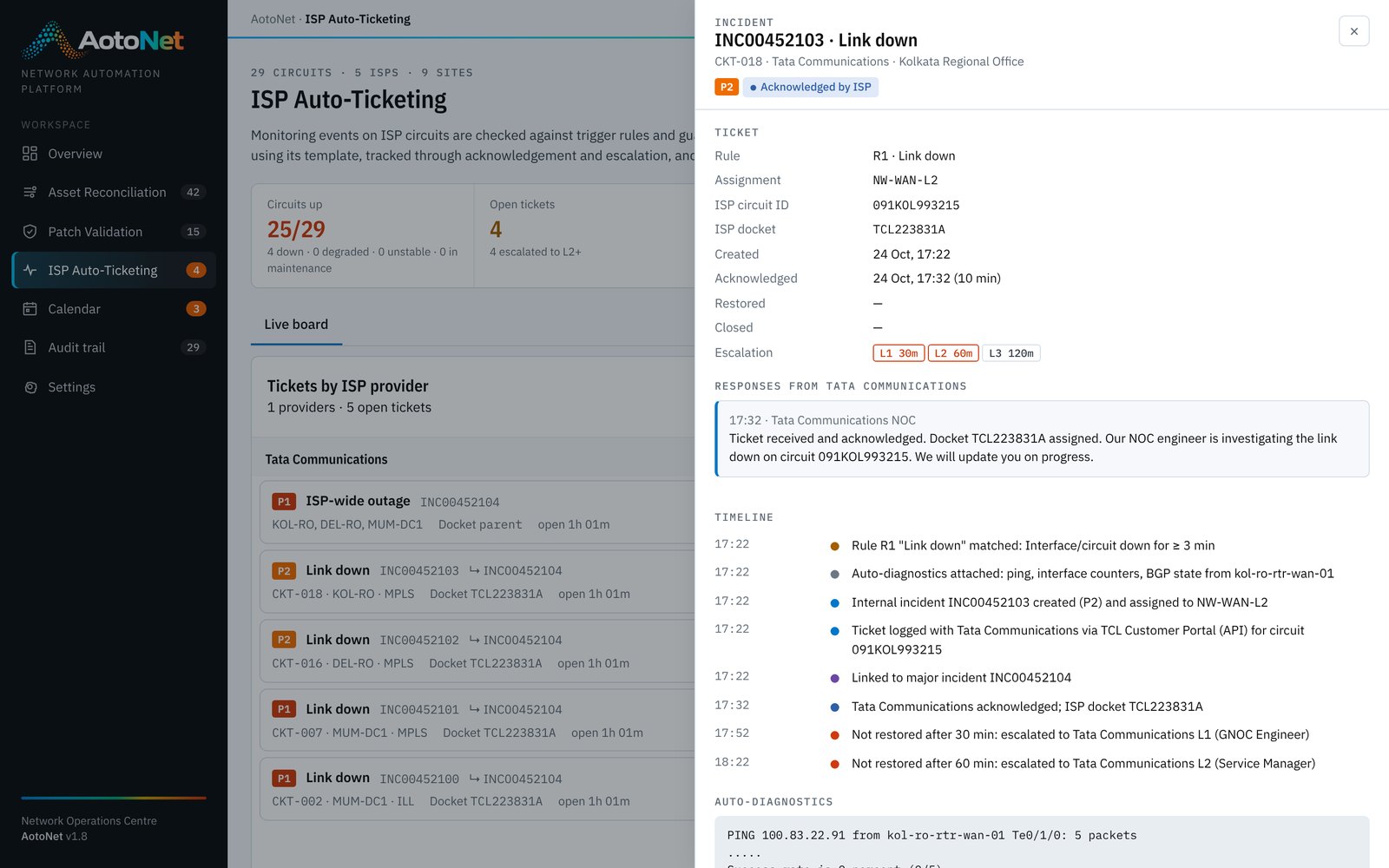
- Attach diagnosticsPing, interface counters and BGP state collected automatically, with a verdict.
- Log with the carrierTicket raised through the carrier's API, portal or email template, plus the internal incident.
- Track and escalateAcknowledgement and docket captured, escalation on the carrier's own matrix, multi-site outages correlated.
- Close with evidenceRestoration detected, stability confirmed, outage duration and MTTR recorded, and the reason for the outage requested.
Side by side
What changes, point by point
| Aspect | Traditional approach | With AotoNet |
|---|---|---|
| Detection to ticket | Whenever someone notices and calls | Logged as soon as the fault passes its hold time |
| Fault validation | Manual checks, often skipped | Guards for maintenance windows, on-premises router health and duplicates |
| Ticket content | Verbal description, details looked up by hand | Carrier template with circuit details and diagnostics attached |
| Multi-site outages | Handled as separate, unrelated tickets | Correlated into one major incident |
| Escalation | Depends on someone remembering | Automatic, on each carrier's own matrix |
| Closure | Manual; reason for the outage rarely collected | Automatic after stability, with MTTR and the reason requested |
| Carrier performance | Anecdotal | Outage and MTTR history for every circuit and carrier |
Capabilities
What ISP Ticket Management includes
Trigger rules
Link down, BGP, packet loss, latency and flapping, each with hold time and priority by circuit criticality.
Guards
Maintenance suppression, on-premises router checks and de-duplication keep tickets accurate.
Carrier templates
Each carrier's logging channel, required fields and escalation matrix configured once.
Major incident correlation
Several circuits from one carrier failing together are grouped automatically.
Live circuit board
Every circuit's state by site: up, degraded, down, unstable or in maintenance.
Full ticket timeline
Detection, diagnostics, carrier responses, escalations and closure in one history.
Benefits of automation
What your team gains
Carriers start work minutes after the fault, not after the first phone call.
Planned work, on-premises faults and duplicates never reach the carrier.
Outage durations and response times for every carrier, ready for service reviews.
Engineers handle exceptions instead of dialling carrier helpdesks.
Connects to
Same platform, same data
Works hand in hand with
See ISP Ticket Management on your own network.
Book a 30-minute walkthrough, then run a pilot on a sample of your own data.